The Wild Beauty of Lake County: Oregon's Last Frontier
There's a part of Oregon that doesn't look like the Oregon most people imagine. No rain-soaked fir forests. No surf-battered coastline. No craft breweries on every corner. Instead, there's a high desert that stretches to the horizon in every direction — sage-covered basins, fault-block mountains rising like walls from the valley floor, and a silence so deep you can hear your own heartbeat.
This is Lake County, and it covers 8,300 square miles of southeastern Oregon with a population density of less than one person per square mile. It's bigger than some states and emptier than most people can imagine. And for those willing to venture here — especially on two wheels — it's one of the most extraordinary landscapes in the American West.
Where the Earth Cracked Open
Lake County's geography reads like a geology textbook come to life. During the Miocene epoch, the earth's crust here began pulling apart, creating massive blocks of rock that tilted and shifted against each other. The rising blocks became mountain ranges. The sinking blocks became broad, flat basins. The result is a dramatic landscape of steep escarpments, alkaline lakes, and volcanic remnants that feels more like Nevada or Iceland than the Pacific Northwest.
Abert Rim is the showpiece. Running for over 30 miles and rising 2,490 feet above the valley floor, it's one of the highest fault scarps in North America — an 820-foot cap of sheer basalt sitting atop layers of ancient volcanic ash. Below it, Lake Abert stretches out like a silver mirror, its alkaline waters supporting clouds of brine shrimp and seasonal explosions of migratory birds. Standing at the base and looking up, the rim blocks out the sky. Riding a bicycle along its base, with the morning sun turning the basalt golden, is the kind of experience that rewires your sense of scale.
The Wildlife Nobody Expects
Lake County is home to Hart Mountain National Antelope Refuge, a 422-square-mile sanctuary established in 1936 to protect the region's pronghorn antelope herds. Today, the refuge shelters over 300 wildlife species, from bighorn sheep navigating cliff faces to golden eagles riding thermals above the sagebrush.
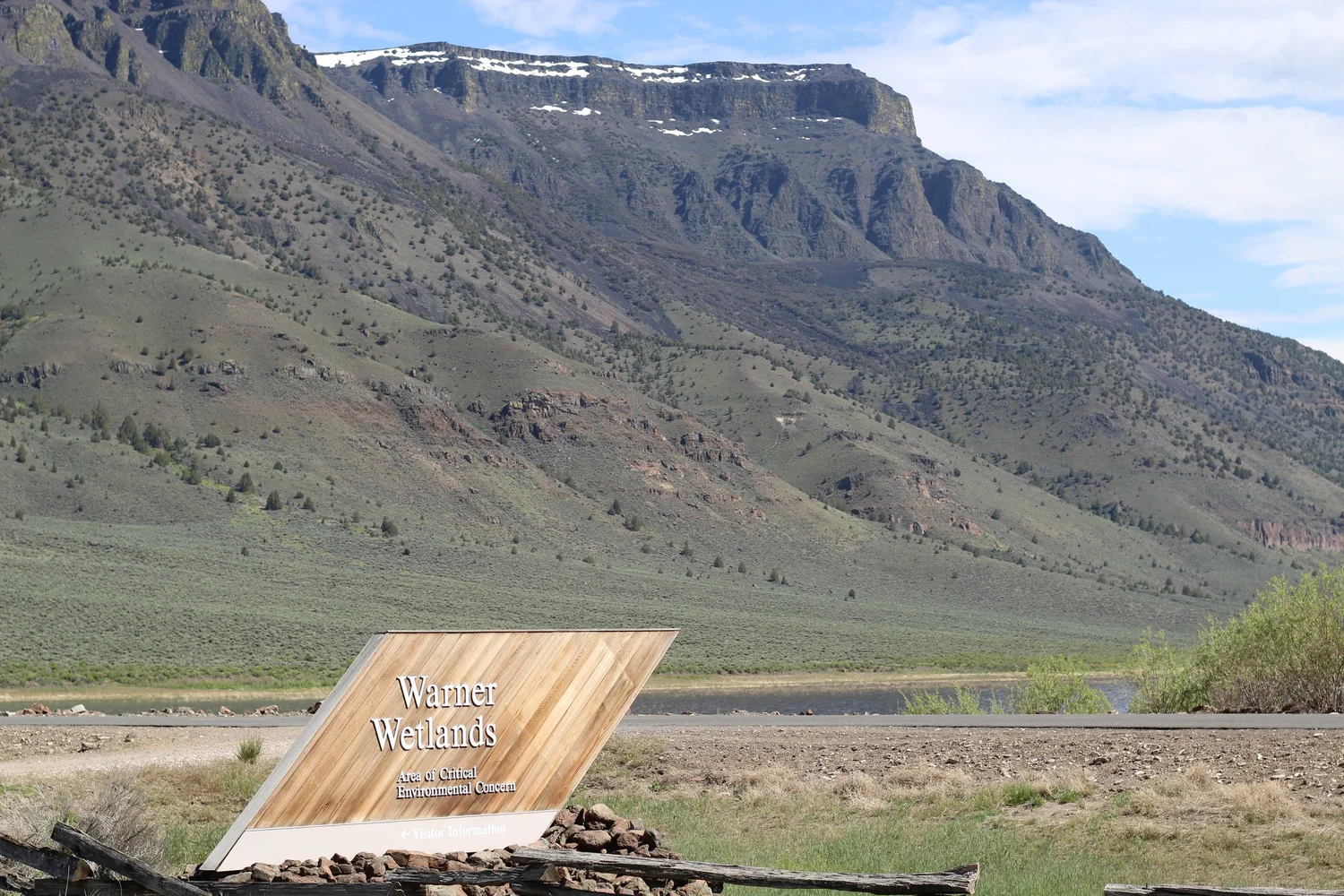
Pronghorn are the signature species — North America's fastest land animal, capable of sustaining speeds of 55 mph across open terrain. Both bucks and does carry horns (unlike deer, which grow antlers), and watching a herd sprint across a sagebrush flat with the Warner Mountains behind them is a sight that stays with you. Mule deer migrate seasonally from as far as Crater Lake, wintering in the gentler terrain around Lakeview and Silver Lake. Sage-grouse, chukar, and California quail populate the uplands, while Summer Lake Basin alone hosts over 250 bird species.
The refuge has no cell towers, no gas stations, and no stores. What it has is a hot spring at the campground — natural, free, and surrounded by nothing but stars and silence.
The Darkest Skies in America
In March 2024, Lake County earned a designation that put it on the map in an entirely new way: the Oregon Outback International Dark Sky Sanctuary. Covering 2.5 million acres — and eventually expanding to 11.4 million — it's the largest contiguous dark sky zone in the United States.
The numbers don't capture the experience. Standing in eastern Lake County on a clear night, you can see galaxies and nebulae with the naked eye. The Milky Way isn't a faint smudge — it's a river of light stretching from horizon to horizon, so bright it casts shadows on the ground. The darkness here is comparable to the Australian Outback, remote parts of South America, and Alaska — except it's a day's drive from Portland.
Eight state and federal agencies have committed to a lighting management plan that will bring every artificial light source in the sanctuary into compliance with dark sky standards within 10 years. It's a long-term bet on something rare and irreplaceable: the ability to look up and see the universe.
Hot Springs, Ranches, and Forgotten Towns
Lake County's communities are scattered across the basins like outposts from another century. Paisley (population 106) sits in the Chewaucan Valley, a historic ranching settlement at 4,548 feet. Silver Lake, established in 1882, still feels like the frontier. Christmas Valley, dreamed up by a developer in 1961 who gave all its streets fanciful holiday names, now survives mostly on alfalfa farming and the peculiar charm of a place that never quite became what its founder envisioned.
Summer Lake Hot Springs is the region's hidden treasure — natural artesian springs at 123 degrees Fahrenheit feeding a century-old bathhouse and a set of outdoor stone-walled soaking tubs. RV and tent camping spots sit steps from the springs, and the property hosts everything from yoga retreats to the annual Outback Music Festival. It's the kind of place where you show up for one night and stay for three.
The ranching heritage runs deep. Lake County's cattle industry dates to the 1870s, when stockmen from the Rogue River Valley drove herds east to the open ranges of Silver Lake and the Warner valleys. The culture they built — buckaroos, branding seasons, multi-generational family operations — persists today. Drive any county road and you'll pass working ranches where the rhythm of the year still follows the cattle.
Why Cyclists Are Calling This Home
For gravel cyclists, Lake County is close to paradise. The road network is vast, the traffic is virtually nonexistent, and the terrain offers everything from rolling ranch roads to lung-busting mountain passes through pine forests and volcanic rock. The Oregon Outback Scenic Bikeway loops 89 miles through the Warner Mountains. The gravel roads around Fort Bidwell cross the Oregon-California border through Surprise Valley, offering panoramic views in every direction.
The Oregon Tour de Outback puts riders directly into this landscape, with routes that climb to Warner Canyon Ski Area, roll through the ranching towns of Plush and Adel, cross sagebrush plateaus punctuated by Deep Creek Falls, and wind through terrain where pronghorn outnumber people by a margin that's hard to overstate.
This isn't a cycling event that happens to be in a nice location. The location is the event. Lake County is the ride.
Ride Oregon's Last Frontier
The Oregon Tour de Outback — June 27, 2026. Five routes through 8,300 square miles of the most beautiful terrain in the West.
Register Now